
The enterprise AI landscape has shifted dramatically. What began as a fascination with conversational AI has matured into a strategic imperative — and the question is no longer “should we adopt AI?” but “which AI architecture is right for us?”
Introduction
When ChatGPT burst onto the scene, it sparked a global conversation about the transformative potential of large language models (LLMs). Enterprises everywhere rushed to integrate it into their workflows — from drafting emails to automating customer support. But as AI adoption deepened, a more pressing question emerged: Is a general-purpose AI like ChatGPT truly built for the demands of enterprise?
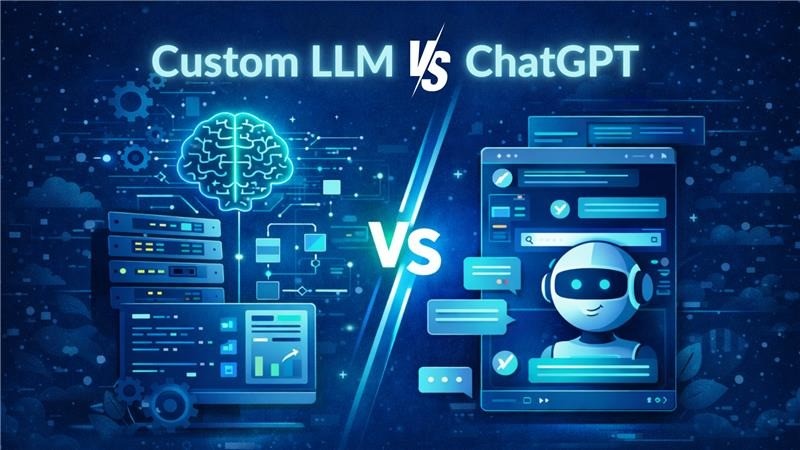
Today, decision-makers face a fork in the road. On one path lies ChatGPT Enterprise — a polished, managed, and readily deployable AI service. On the other hand lies a custom LLM — a purpose-built model trained on proprietary data, deployed on controlled infrastructure, and tailored to a specific industry or business context.
This blog unpacks both approaches across the dimensions that matter most to enterprises: data privacy, customisation, cost, compliance, and long-term strategic value.
What Is ChatGPT Enterprise?
ChatGPT, developed by OpenAI, is a pre-trained conversational AI that requires minimal setup and is accessible through APIs or intuitive interfaces. Businesses can integrate it into websites, applications, CRMs, or support systems without building a model from scratch.
The Enterprise tier adds meaningful features for organisational use:
- OpenAI contractually commits to not using customer data for model training
- SOC 2 Type II compliance, SSO integration, and admin controls
- Data encryption in transit and at rest
- Custom GPTs and API access for integration
- Access to frontier models (GPT-4o and beyond) with automatic updates
For teams that need to move fast, ChatGPT Enterprise removes nearly all operational overhead.
What Is a Custom LLM?
A custom LLM is a large language model tailored specifically to an organisation’s needs. It can be built from scratch or, more commonly, fine-tuned from a strong open-source base (such as Llama 3, Mistral, or Phi-3) using proprietary datasets.
Unlike general-purpose models, a custom LLM is trained on targeted, domain-specific data, making it more specialised in its outputs. It can be deployed on-premise, in a private cloud, or in a dedicated cloud tenant — ensuring that data never leaves the organisation’s controlled environment.
Custom LLMs are not a product. They are a capability – one that enterprises build to embed AI deeply into their operations.
The Core Trade-off: Control vs. Convenience
At the heart of this decision lies a fundamental tension. ChatGPT Enterprise optimises for convenience: fast deployment, automatic updates, no infrastructure burden, and access to world-class model quality. Custom LLMs optimise for control: full ownership of data flows, the ability to fine-tune on proprietary content, and complete independence from third-party policy changes.
Neither is inherently superior. The right choice depends on your use case, regulatory environment, and organisational maturity.
Dimension 1: Data Privacy and Security
This is where the decision often crystallizes, particularly in regulated industries.
ChatGPT Enterprise offers robust contractual protections — OpenAI’s SOC 2 certification, encryption standards, and a commitment not to train on customer data are meaningful safeguards. However, one critical reality remains: your data transits OpenAI’s infrastructure. For many organizations, this is acceptable. For others, it is a non-starter.
Custom LLMs eliminate this concern entirely. Data never leaves your environment — whether that is an on-premise server or your organization’s isolated cloud tenant. You own the entire data flow, from input to output, with full control over access logs and retention policies.
In healthcare, this matters enormously. While OpenAI does offer a Business Associate Agreement (BAA) for HIPAA compliance, many healthcare compliance teams remain uncomfortable with protected health information (PHI) transiting any third-party AI infrastructure, regardless of contractual commitments. For clinical NLP applications, diagnostic support tools, and patient communication automation, private LLM deployment is typically the conservative and preferred path.
Similarly, financial institutions operating under FFIEC or NCUA guidelines face third-party vendor due diligence requirements when using managed AI services for member-facing or account-data-adjacent applications. A custom deployment within an existing security perimeter is often the cleaner compliance story to present to examiners.
Verdict: If sensitive data — PHI, PII, financial records, or student records — is central to your use case, a custom LLM is the only option that provides unequivocal data isolation. If contractual protections from a SOC 2-certified provider satisfy your compliance requirements, ChatGPT Enterprise is a viable path.
Dimension 2: Customisation and Domain Accuracy
ChatGPT Enterprise offers meaningful customisation through system prompts, custom GPTs, and retrieval-augmented generation (RAG) over organisational documents. For most general knowledge work — drafting communications, summarising documents, answering broad questions — this level of customisation is sufficient.
The limitation is architectural. You cannot modify the underlying model weights. You work within the boundaries of what OpenAI ships, and the model’s foundational knowledge remains trained on public internet data.
Custom LLMs remove this ceiling. Full fine-tuning capability means you can train the model directly on your organisation’s data: your legal department’s contract templates, your hospital’s clinical protocols, your bank’s lending policies, and your engineering team’s internal documentation. The result is a model that understands your terminology, reflects your brand voice, and generates outputs calibrated to your specific context.
Fine-tuned domain-specific models consistently outperform general models on specialised tasks, often by a significant margin. In industries where terminology precision matters – legal, medical, financial, and governmental – this accuracy gap translates directly into business value.
Verdict: For general productivity use cases, ChatGPT Enterprise’s customisation is sufficient. For domain-specific applications where accuracy on proprietary terminology and processes is critical, fine-tuning a custom LLM delivers meaningfully better results.
Dimension 3: Cost Structure
Cost is perhaps the most nuanced dimension of this comparison, because the answer changes dramatically based on scale and use case.
ChatGPT Enterprise is priced at approximately $60 per user per month, making it predictable and attractive for organisations onboarding many employees. For a team of 100, that is roughly $72,000 annually — with no infrastructure costs and no ML engineering overhead. For general productivity use cases across a broad user base, this is a compelling value proposition.
However, this model has a ceiling. As API call volume grows — particularly for customer-facing applications with thousands of daily interactions — token-based pricing can escalate rapidly. The per-seat model also doesn’t fit well for applications where the “user” is an automated pipeline rather than a human employee.
Custom LLMs require significant upfront investment. Cloud GPU hosting for a small 7B-parameter model runs $500–$2,000 per month; larger production-grade models can reach $5,000–$15,000+ monthly. Add ML engineering for setup, optimisation, and maintenance — $5,000 to $20,000 per month if outsourced — and initial setup costs commonly range from $15,000 to $50,000 with consulting support.
The economics shift at scale. For high-volume API usage, customer-facing automation, or applications where ChatGPT Enterprise’s per-seat pricing doesn’t fit the usage model, a custom LLM becomes cost-competitive and eventually more economical over time.
Verdict: ChatGPT Enterprise wins on short-term cost-efficiency for general, multi-user productivity. Custom LLMs become cost-competitive — and often superior — at high API volume, for customer-facing deployments, or when long-term cost optimisation is a strategic priority.
Dimension 4: Deployment and Operational Burden
ChatGPT Enterprise is operationally straightforward. IT provisions user accounts, configures SSO, and establishes usage policies. OpenAI handles infrastructure, scaling, security patching, and model updates. Deployment can typically be completed within one to two months of procurement.
Custom LLMs demand substantially more: infrastructure provisioning, model deployment, scaling architecture, monitoring, security patching, and periodic retraining. This requires dedicated ML engineering expertise — either built internally or sourced through a consulting partner. Ongoing maintenance typically demands 10–20 hours per month minimum for a production deployment.
This operational gap is real and should not be minimised. Organisations that lack ML engineering capability and need to move quickly will find that ChatGPT Enterprise removes enormous friction.
Verdict: If speed to deployment and minimal operational overhead are priorities, ChatGPT Enterprise wins decisively. Custom LLMs are the right investment for organisations with (or willing to build) ML engineering capability.
Dimension 5: Model Quality and Capabilities
At the frontier of general-purpose AI capability, OpenAI’s models currently lead. GPT-4o and its successors consistently rank among the top-performing models for complex reasoning, broad knowledge retrieval, and open-ended generation tasks. ChatGPT Enterprise users benefit from these improvements automatically, without any internal effort.
Open-source models have closed the gap significantly, but for general-purpose tasks, frontier models still hold an advantage. That said, this is a moving target — the gap between open-source and proprietary models continues to narrow with each new release.
Where the calculus shifts is domain-specific performance. Fine-tuned custom LLMs, trained on high-quality proprietary data, can match or exceed GPT-4-level performance on narrow, specialised tasks. A model fine-tuned on 10 years of a law firm’s contracts will outperform a general model on legal document analysis. A model trained on a hospital system’s clinical notes will perform better on medical coding and documentation tasks than any general-purpose alternative.
Verdict: For general-purpose quality, ChatGPT Enterprise holds the edge. For specialised tasks with strong fine-tuning data, custom LLMs are competitive and often superior.
Dimension 6: Consistency and Governance
One underappreciated challenge with general-purpose models is output unpredictability. ChatGPT’s broad training optimises for versatility, which can produce inconsistent results for niche, highly specialised, or internally-constrained use cases.
Custom LLMs, by focusing on narrower datasets and specific business contexts, tend to produce more consistent and predictable outputs. They can also be embedded with organisational governance frameworks — output constraints, bias mitigation controls, hallucination safeguards, clear audit trails, and human-in-the-loop oversight — that are far harder to enforce in a managed service environment.
For enterprises in regulated industries, these governance capabilities are not optional features. They are table stakes.
Industry-Specific Considerations
Healthcare
Regulatory frameworks around PHI, combined with the clinical stakes of AI-generated outputs, make private LLM deployment the conservative choice for most healthcare organisations. For patient-facing applications, clinical documentation, and diagnostic support, a custom LLM within an existing HIPAA-compliant environment is typically preferred.
Financial Services
Applications touching member financial data – loan document analysis, fraud pattern detection, and regulatory compliance workflows – benefit from the clean compliance story of private deployment. ChatGPT Enterprise is often acceptable for internal staff productivity tools where sensitive data is not involved.
Legal Services
Legal document analysis demands both terminological precision and strict confidentiality. Custom LLMs fine-tuned on internal contract libraries and case history offer advantages that general models cannot replicate.
Higher Education
Under FERPA, student education records require careful handling. A private LLM deployment with controlled access and audit logging provides stronger guarantees for student-facing applications like AI tutoring, advising chatbots, or academic record processing.
Retail and Manufacturing
For inventory prediction, sentiment analysis, and product recommendation engines — where proprietary transaction and behavioural data drives model performance — Custom LLMs built on internal datasets can deliver a significant competitive advantage.
The Hybrid Approach: Often the Right Answer
It is worth noting that this is not a binary choice. Many enterprises benefit from deploying both approaches simultaneously, with clear policies governing which tool is used when.
The most common pattern in mature enterprise AI deployments is:
- ChatGPT Enterprise for general staff productivity — drafting, summarization, research, meeting notes — where no sensitive data is involved
- Custom LLM for specific, high-value applications involving regulated or proprietary data
This hybrid approach balances cost, convenience, and compliance. It also allows organisations to build AI literacy with ChatGPT Enterprise while developing the internal capability to deploy and maintain custom LLMs for the use cases that demand it.
A Decision Framework
| Factor | Choose ChatGPT Enterprise | Choose a Custom LLM |
| Primary use case | General productivity, content, and research | Domain-specific, regulated, proprietary data |
| User base | Many employees, broad productivity | Automated pipelines or specialised teams |
| ML capability | Limited or none | Available in-house or via consulting |
| Data sensitivity | No sensitive data involved | PHI, PII, financial records, IP |
| Compliance | SOC 2 contractual protections are sufficient | Regulators require internal data custody |
| Timeline | Fast deployment needed | Longer-term investment acceptable |
| Cost priority | Predictable per-seat spend | Long-term optimisation at high volume |
| Customisation needs | Prompts and RAG are sufficient | Fine-tuning on proprietary data is required |
Responsible AI: A Non-Negotiable in Either Path
Whichever architecture you choose, enterprise AI deployment demands more than performance — it demands principles. Any production LLM deployment should integrate bias mitigation strategies, hallucination safeguards, clear audit trails, human-in-the-loop oversight for high-stakes outputs, and compliance frameworks appropriate to your industry.
Custom LLMs offer more architectural control over these governance mechanisms, but the discipline of responsible AI must be applied regardless of whether you are calling an API or running your own model.
Conclusion
ChatGPT moved AI from the research lab to the boardroom. But moving from experimentation to enterprise-grade deployment is a different challenge — one where speed-to-market, data sovereignty, regulatory compliance, and long-term strategic value must all be weighed carefully.
For organisations seeking rapid deployment, broad user access, and general productivity gains without sensitive data exposure, ChatGPT Enterprise is a mature, cost-effective, and high-quality solution.
For organisations that require full data control, deep domain specialisation, regulatory compliance with strict data residency requirements, or AI as a differentiating competitive asset, custom LLM development represents the more appropriate long-term investment.
The right AI strategy is not the most powerful one. It is the one that aligns with your data environment, your regulatory obligations, your operational capacity, and your business objectives. Many organisations will find that the optimal answer is not one or the other — but a thoughtful combination of both.
The most important thing is to start with clarity on what you are actually trying to solve.

Helping you stay informed, updated, and ahead in tech.