

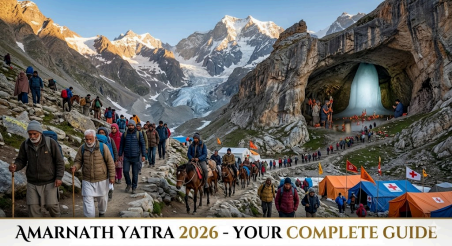
When I first started looking into Amarnath Yatra, I was completely stressed. There’s so much information floating around online, so many travel operators are promising the world, and so many “must-do” lists that deny each other. I didn’t know where to begin.
Whether you’re a first-timer trying to figure out the basics or someone who’s been putting this yatra off for years, this guide is for you. No fluff—just real, practical information about what this journey involves and how to actually prepare for it.
What Is It Really Like — Beyond the Brochures?
People who’ve done the Amarnath Yatra will tell you two things together. One — it’s physically harder than you expect. Two, it offers a profound spiritual satisfaction.
The holy Amarnath cave is at 3,888 meters above sea level in Jammu & Kashmir. Inside it, a naturally formed ice Shiva lingam appears every year during the summer months. The yatra officially opens and closes each year based on the Shravan calendar, and in 2026, it’s expected to run from 3rd July to 9th August—roughly 38 days.
Now here’s where it gets real. You’re walking through mountain terrain, often in cold and wet conditions, at altitudes where the air is noticeably thin. Your body will feel it. Your lungs will feel it. And yet — people do it every single year, including elderly devotees in their 60s and
70s. Because when you finally reach the cave and stand in front of Baba Barfani, none of that exhaustion matters anymore.
That moment makes everything worth it. Every blister, every cold night, every breathless step.
The Two Routes — Which One Is Right for You? This is usually the first question people ask, and there’s no one-size-fits-all answer.
The Pahalgam route is 48 km and takes around 5 to 6 days. It’s gradual, scenic, and honestly the better option for first-timers, families, or anyone not used to trekking. You get proper acclimatization time, there are medical camps along the way, and the views of Kashmir’s valleys are something you’ll carry with you forever.
The Baltal route is only 14 km, but don’t let that fool you—it’s steep and demanding. Experienced trekkers who are short on time often prefer this route. You can complete it in 1 to 2 days, but your body needs to be ready for it.
And then there’s the helicopter option. If you’re an elderly pilgrim, traveling with young kids, or simply don’t have a week to spare, the helicopter from Neelgrath (Baltal sector) or Pahalgam to Panchtarni takes just 8 to 15 minutes. From Panchtarni, there’s still a 6–7 km walk to the cave, but it’s manageable for most people.
Registration — Don’t Leave This for the Last Minute
This is where a lot of people trip up (pun intended). Registration for the Amarnath Yatra is mandatory and has to be done through the official Shri Amarnathji Shrine Board (SASB) website. You’ll need your Aadhaar card and a compulsory health certificate, which includes a basic fitness check, blood pressure test, and ECG. The certificate has to be issued within 7 days of your yatra start date.
Registration typically opens around April–May each year, and helicopter slots in particular fill up extremely fast. If you want a specific date, don’t wait.
Finding a Reliable Tour Operator — This Part Matters More Than You Think
I cannot stress this enough — who you travel with will make or break this experience.
I came across Amarnath travel packages 2026 by Epic Yatrawhile doing my research, and what caught my attention was how upfront they are about everything. They’re Ministry of Tourism approved (EUP000994), registered with UP Tourism, and have been running pilgrimage tours since 2015—with over 5,000 Amarnath Yatras organized so far. Their Google reviews are genuinely good, not the kind that feel copy-pasted.
Their packages start at ₹16,500 per person and cover everything from SASB registration help and medical support to accommodation, transfers, vegetarian meals, and experienced guides on the ground. There are no surprise charges.
For those specifically looking at the helicopter route, their Amarnath Yatra by Helicopter via Jammu is a clean, well-structured package—confirmed return helicopter tickets, VIP darshan support, and a dedicated team that stays with you through the journey.
If you’re more of a trekker, the budget and standard trekking packages via Baltal and Pahalgam are worth a look too. Prices range from around ₹12,000 for a budget trek to ₹75,000 for a full luxury helicopter experience—so there’s genuinely something for every budget.
A Few Things I’d Tell Anyone Going for the First Time
Start preparing your body at least 2 to 3 months before. Daily walks, uphill practice, and pranayama go a long way at altitude. Don’t assume you’ll just figure it out on the way.
Drink water constantly. Altitude sickness sneaks up on you, and dehydration makes it worse. Aim for 3 to 4 liters a day during the yatra.
Layer your clothing. It can be warm in the valley and absolutely freezing near the cave — sometimes within the same day. Thermals, a good windcheater, and woolen socks are non-negotiable.
Carry cash in small denominations. ATMs are limited in the mountains, and you’ll need cash for ponies, porters, langars, and local purchases.
Listen to your body. If you’re feeling dizzy or nauseous or have a persistent headache, don’t push through it. Descend and get help. No darshan is more important than your safety.
Final Word
The Amarnath Yatra is not a holiday. It’s not a vacation you come back from feeling relaxed. It’s a test of your faith, your body, and your patience. And it’s one of the most profound things a person can do.
If 2026 is your year for this journey, plan early, prepare genuinely, and travel with people who know what they’re doing. The mountains of Kashmir, the sound of Har Har Mahadev echoing through the valley, and that first sight of the ice The lingam inside the cave—it’ll stay with you for the rest of your life.
Read More

Helping you stay informed, updated, and ahead in tech.